
Today’s almost-daily dispatch is brought to you by a sink full of soapy water and sticky nectar.
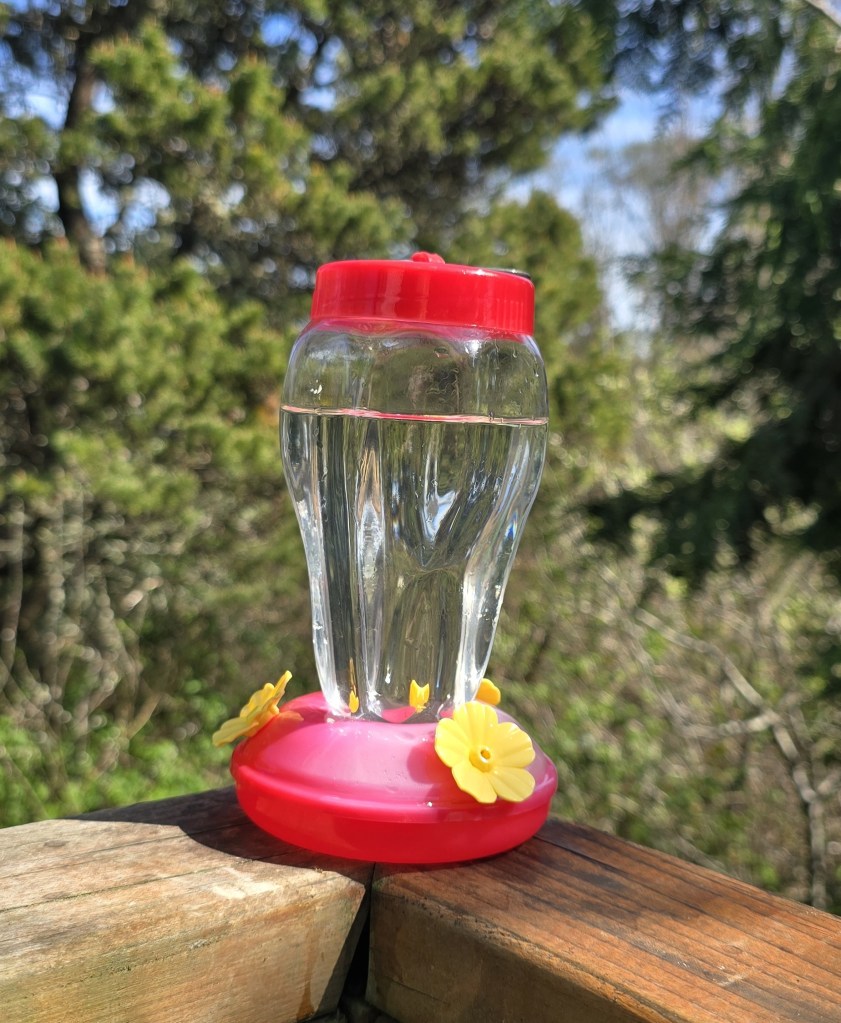
I just spent twenty minutes attacking my Dollar (ahem… $1.25) Tree hummingbird feeders with a toothbrush, toothpicks, and every other fine-pointed tool I could find. This past week, I noticed one feeder had a steady stream of hungry customers, while the other was a ghost town. The two feeders are only eight feet apart. Same model, same liquid.
Somewhere in the ADHD filing cabinet of my brain, I remembered that hummingbirds are incredibly cautious with the feeders we “human folks” provide. If they drink nectar from a moldy feeder, it can be life-threatening. A quick Google search confirmed my brain was, indeed, spitting residual facts back into my frontal lobe.
Per The Murfreesboro Pulse: “Fungal infections… from moldy nectar cause their tongues to swell, making it impossible to feed, ultimately resulting in starvation. Mold spreads rapidly in warm, sunny weather and in dirty, uncleaned feeders.”
Just as I suspected, one feeder had mold blooming in the tiny feeding tubes while the other was perfectly clean. Hummingbirds can detect even a trace of mold through those long beaks and will fly away from a feeder at the slightest hint of it. As I scrubbed, it struck me: there’s a life lesson here. At first glance, these little hummers might look like finicky princesses. In reality, they are master survivalists. Their senses are saving their lives.
Reflecting on my own journey, there have been many times a situation started to “go bad” and I ignored it. There were moments I put blinders on to the mold spores growing on a situation and delved head-first into a toxic environment. And, in a moment of honesty, there were also times I treated a situation like a personal petri dish—injecting my own toxic habits into it just to see what kind of chaos I could bloom.
But what if?
What if we honored our own sensory messages more?
What if we trusted ourselves when something didn’t feel right, or when someone’s tone hit a sour note?
What if we only indulged in food that actually nourished us?
What if we only consumed the music, stories, and social media that fed our souls, rather than the doomscrolling we all fall victim to?
If a hummingbird is designed to detect the slightest trace of mold—rejecting the temptation of the nectar to ensure its survival—what does that say about our own human design? Are we not also capable of so much more?
Today, I’m challenging myself to tap deeper into my discernment.
I’m challenging myself to trust my instincts more and doubt them less.
I’m challenging myself to treat my time, my energy, and my focus as the valuable commodities they are.
And fellow traveler, I challenge you to do the same.
 Joy On A Journey